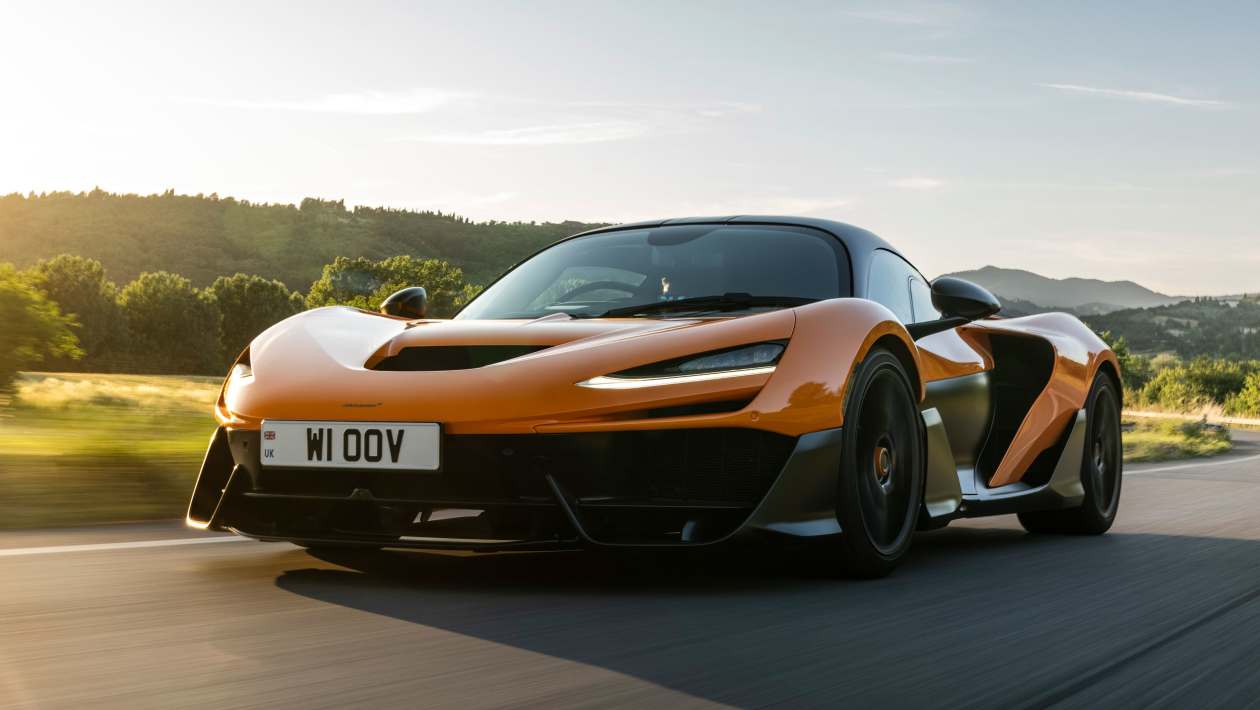
Following the F1 and P1 is a bit like applying to be the third member of the Beatles after John Lennon and Paul McCartney. It’s a tough gig. But the McLaren W1 is a fabulous and surprisingly easy car to drive. A mixture of old and new-school, it is sensationally fast, yet is also tactile at low speeds. If you’re lucky enough to be one of the 399 new owners spending $2.5 million on your next hypercar, then you have a hit on your hands.
The new McLaren W1 is the most powerful and quickest road car the Woking-based company has ever produced. That’s quite a statement given McLaren’s back catalogue. Like its direct predecessor, the P1, this new model is a hybrid hypercar with all the power going to the rear wheels alone. Total outputs are frankly enormous at 1,257 horsepower and 1,230 lb-ft of torque. For comparison, the P1 produced 903 horsepower and 723 lb-ft of torque – and both cars weigh almost exactly the same, tipping the scales at just under 3,086 pounds dry.
 View Price on Amazon
Positioned in the middle of the car is a 4.0-liter, twin-turbo V8 and although that might sound like a familiar McLaren engine, it is in fact all-new. It is 29 pounds lighter and 1.6 inches shorter than the previous V8 (that can still be found in the 750S), and as well as bigger turbos it has both direct and port-injection to allow it to rev higher. On its own the V8 produces a monumental 915 horsepower and 900 lb-ft of torque – considerably more than most ‘ordinary’ supercars.
Used - available now: 2023 Volkswagen ID.4, 2023 Mercedes CLA, 2020 Volkswagen Tiguan AllSpace, 2023 Lexus UX.
Behind the engine is an eight-speed, dual-clutch gearbox and alongside that is the radial flux e-motor. Powered by a 1.4kWh battery, this electric motor adds another 342 horsepower and 440 lb-ft into the mix. Although the W1 is capable of running as an EV, and indeed relies on it for reversing, the range is a meager 1.6 miles because of the small size of the battery. It’s just enough to get you away from the house in the morning without waking everyone up – but not much more.
However, zero emissions motoring is not what this specific hybrid is about. It’s about going incredibly quickly, and the W1 has definitely got that covered. The official acceleration figures begin with 0-60mph in 2.7 seconds, which is quick but not exceptional these days and speaks to the fact that all the power is reaching the tarmac solely through the 335-section rear tires. Indeed, many of the W1’s rivals – like the Ferrari F80 and Aston Martin Valhalla – get better traction by using all four wheels.
The 0-124mph time of 5.8 seconds and 0-186mph time of under 12.7 seconds are both phenomenal and put it on a par with the extreme Aston Martin Valkyrie – and on the track the W1 certainly lives up to its billing, shrinking straights in a way that would probably impress McLaren’s F1 drivers.
But it has the corners covered too because the Race mode drops the ride height and extends the rear wing to increase the downforce from 200kg in its Sport setting to a massive 1,000kg. The active rear wing also acts as an air brake and can drop into a drag reduction mode when necessary. Aerodynamics are often hard to assess in isolation, but it was immediately clear through the high speed sections of the Mugello circuit that the W1 feels incredibly stable, inspiring confidence at high speed.
The other thing that gives the driver huge reassurance is the braking system. McLaren has always been renowned for its superb brake feel and the W1 is no different, with the set-up remaining purely hydraulic. However, these new carbon discs have an extra layer of ceramic coating on them to increase durability and allow for more aggressive brake pads for extra stopping performance. As an example of just how capable they are, we were hitting over 200mph on track before braking at the 200m-board going into the slow first corner.
Source: autoexpress.co.uk

