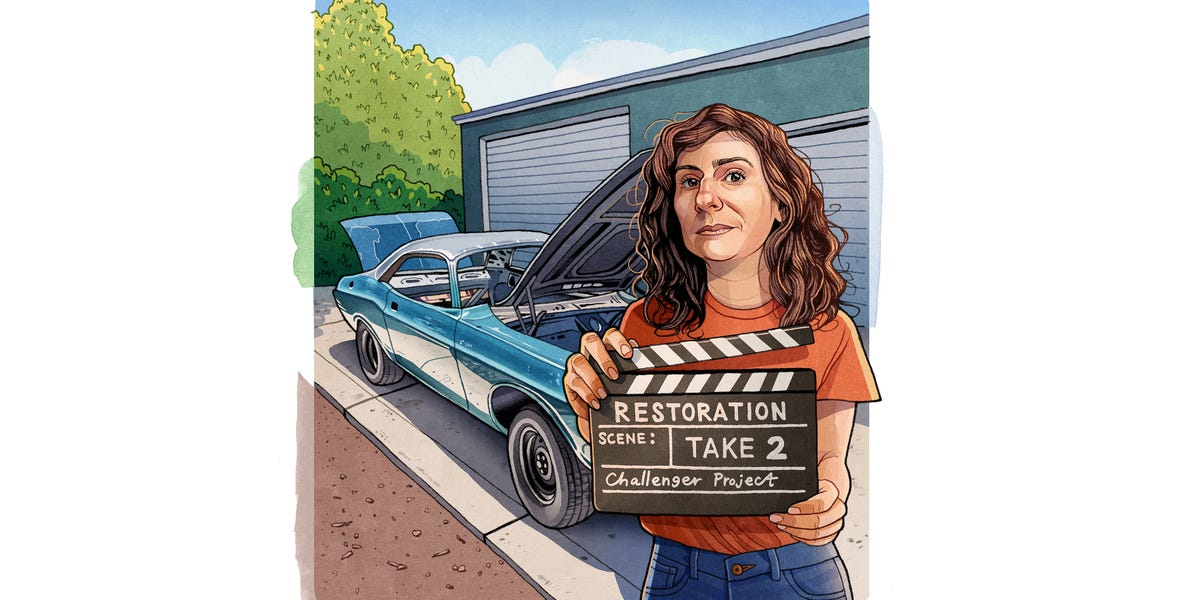
Second chances aren’t just for rom-coms. Sometimes project cars give you another shot at love—and paint. From the July/August 2026 issue of Car and Driver.
I'm restoring my 1970 Dodge Challenger for the second time. No dramatic accident preceded this, only the inexorable march of time. It turns out that if you buy a 33-year-old muscle car, slap some paint on its flanks, drop a junkyard RV motor under its hood, and then drive it regularly until it's a 56-year-old car, you'll get to do it all over again.
When my husband and I bought the base-trim Challenger from the original owner, it had a lot of miles on the odometer and an unfortunate recent history of sitting under the neighbors' sprinkler. On its roof, where the cracked vinyl top held water against unpainted metal, corrosion was eating tiny pinholes through the steel.
 View Price on Amazon
Initially, we weren't even planning on keeping the car. I already had a Challenger. It was a brute of a '72, with a transplanted V-8 and a rattle-can-black paint job that caused curtains to twitch when I parked in L.A.'s nicer neighborhoods. I was perfectly happy with my rat-rod muscle car, but then the '70 came home from the paint shop, glistening blue like a cartoon dolphin. I immediately forswore the dirtbag life, sold the '72, squeezed a 440-cubic-inch big-block under the blue Dodge's hood, and stuck it into service as both daily driver and weekend drag car.
I kept it humming, commuting first to a job at a PR firm and later 60 miles round trip to the Hot Rod magazine offices before embarking on various excursions as a freelance writer and a Car and Driver staffer.
Not only did the Dodge handle transportation duties and quarter-mile runs, but it also did a stint as a prototyping mule for an aftermarket suspension company, made an appearance on American Top Gear, and participated in several magazine dyno tests and photo shoots. I cannot tell you how many burnouts it did, only that one was in front of a police officer who did not find it funny when I said, "Sorry, I didn't see you through all the smoke."
All things return to the earth, and the hot hours on the freeway and steady kick of grit from the racetrack accelerated the Challenger's slide back to jalopydom. The paint cracked along the quarter-panels. The little holes in the roof spread, dimpling under the peeling clear-coat. The scratch in the front fender bled a rusty stain just below the side marker light, a humiliating reminder that I rolled into a post at the gas station one week after getting the car painted the first time. It was looking ragged, and not in a cool patina way.
Having already attempted a quick fix on the roof, I knew that this time it needed a full replacement. Aftermarket body panels are available for first-gen Challengers, so one exorbitant shipping cost later, I had a new roof ready to go to Peter the Swede. Peter, a metalworker friend who specializes in Mopars, is actually Finnish, and I do not know why everyone calls him the Swede, other than a general ignorance of Nordic peoples.
As is always the case when you bring a project from one craftsperson to another, Peter was unimpressed by the previous bodywork. He texted me daily updates as he excavated layers of unnecessary Bondo and other surprises. The other surprises were rust. Car surprises are always rust, except when they're blown head gaskets. Once Peter had cut out all the rust, next came further disassembly to get the Challenger ready for paint.
One of my favorite things about buying a new (old) car is finding little clues about the previous owner: a collection of national-park maps in the glovebox, a pile of beer-can tabs behind a door panel, seven cloves of garlic tucked in the trunk. Now I got to do the same thing, but with myself. All this sand in the vents? That's from some off-roading when the hairpin at Buttonwillow Raceway proved too hairy. These
Source: caranddriver.com