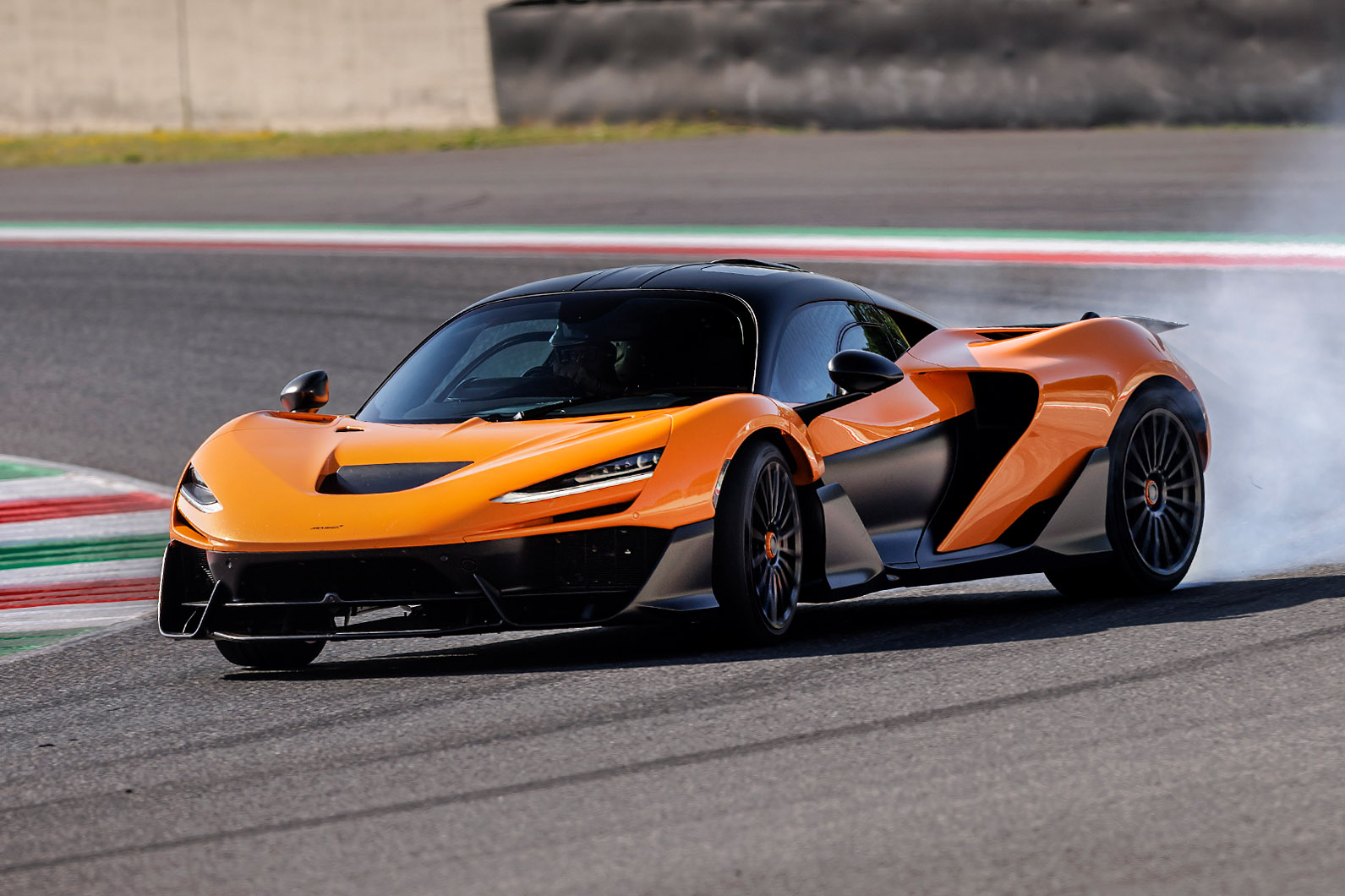
There is a recent trend for hypercars to have four-wheel drive, with engines typically in their middle and supplemented by electric motors at the front. And with good reason, because more than 1000 horsepower is an awful lot for two wheels to deal with by themselves. Some engineers say that to get the best out of so much power, it must be distributed through four tires.
McLaren engineers don’t feel the same. This is the W1, McLaren’s latest Ultimate Series hypercar and the third in the lineage of ‘1’ cars, after the F1 and P1 (and only the second ‘1’ during the new iteration of McLaren’s road car division). Like those, it is carbon fiber-tubbed and mid-engined – and exclusively rear-wheel drive.
As with the P1 it’s a hybrid, but this time it can’t be plugged in, because that would make it heavier. McLaren has taken a different path from some of its competitors by attempting to rule out anything that adds unnecessary weight. So, as with equipping it with rear-wheel drive only, it has opted for a mechanical layout that makes the car as light as is realistically possible. McLaren claims a lightest dry weight of 3086 pounds (I’d prefer a wet curb weight, but rivals use this number too). Anyway, you can imagine how hard they will have worked for the last pound.
 View Price on Amazon
The W1’s chief engineer, Andy Beale, showed me around an unclothed W1 in the garages at Mugello circuit, which is just 70 miles from Ferrari’s home in Maranello. You can read something into that if you like: it isn’t the first time McLaren has, figuratively or literally, arrived on Ferrari’s patch – although it may just be due to circuit suitability and availability for this car and at this time of year.
At the W1’s front there’s an aluminum crash structure, which also holds the bodywork and some of the W1’s (many) cooling radiators, but the suspension and steering rack are both mounted directly to the carbon fiber tub.
In Race or Race+ modes, the ride height is lower, by 1.5 inches at the front and only 0.7 inches at the rear, because they want to change the angle of attack too.
Torsional rigidity is a claimed 31,914 lb-ft/degree, and the tub, including all of its metal inserts, weighs 154 pounds. Suspension is by double wishbones front and rear, with coil springs and adaptive dampers. There is no 48V trickery or linked hydraulics or stuff like that: by the time you’ve added inverters and so on, says Beale, it all gets too heavy.
But there is some suspension magic going on. At the front the W1 is low, and there are pushrods because that helps keep the damper units lower, so the scuttle is lower and the driver lower, yet visibility remains fine.
Beale had to explain the suspension to me twice before I totally got it, but here goes: in the standard ride height there are two drive modes available: Comfort and Sport. The only difference is between them is damper stiffness.
There is a blank section within the spring/damper unit that gets compressed when the ride height is dropped. It doesn’t affect the coil spring, the rate of which is unchanged. However, McLaren wanted the spring rate to increase when Race mode/height was engaged. So there are what look like anti-roll bars and what McLaren calls ‘heave bars’ front and rear.
Source: autocar.co.uk

