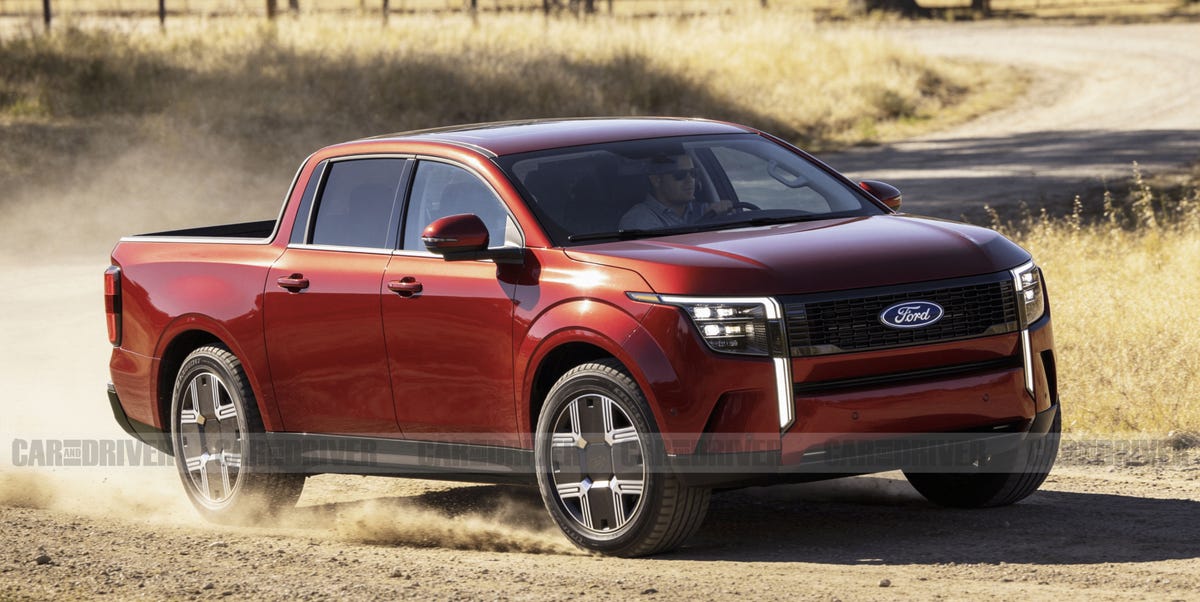
While Ford hasn't yet confirmed the name—or many other details, for that matter—its upcoming EV aims to change the game. Ford is betting big that its upcoming "Universal Electric Vehicle" platform and production process will do for electric vehicles what the Model T did for automobiles—essentially make them more affordable to more people.
The first of several variants to spawn from Ford's Universal EV platform will be a currently nameless electric truck that will start at around $30,000 and enter production sometime in 2027. While Ford has remained mum on what its upcoming pickup will be called, the company's affinity for reviving recognizable nameplates (see the F-150 Lightning and Maverick) and a relatively recent trademark filing lead us to believe it'll be called "Ranchero."
Americans' interest in new electric vehicles appears to be largely linked to affordability, at least judging by the sales slowdown that followed the Trump administration's elimination of the federal tax credit. Currently, the Chevy Bolt and Nissan Leaf are the only EVs you can buy with starting prices below $32,000; the forthcoming Slate truck will start north of $25,000 when it goes on sale, but adding features will greatly inflate the price.
 View Price on Amazon
So, the Ford Ranchero has a chance to capitalize on limited direct competition and this country's appetite for cargo-bed-toting transportation. If Ford's promised starting price of around $30,000 sticks, it could be good for both the company and consumers. Ford's Universal EV platform will underpin the Ranchero as well as several other body styles. The modular architecture can be configured to support everything from subcompact vehicles to three-row SUVs to commercial vans.
When visiting Ford's Electric Vehicle Development Center in Long Beach, California, we saw the UEV platform split into three parts: two large castings that form the front and rear subsections and sandwich a battery pack that acts as both a structural subassembly and the vehicle's floor (the body sits atop this foundation). While the Ranchero will have a footprint similar to the compact-sized Maverick, Ford claims the EV's packaging will provide more interior volume than a Toyota RAV4, and that's not including the additional cargo space provided by the front trunk and cargo bed.
Compared with a traditional vehicle, Ford claims the UEV platform has 20 percent fewer parts and 20 percent fewer fasteners, and it utilizes a new type of wiring harness that's lighter and more compact than the company's first-generation electric vehicles. Despite slower charging speeds, Ford also chose a 400-volt architecture instead of an 800-volt system, but the company believes that's a worthy compromise to help meet its affordable price point.
Source: caranddriver.com

