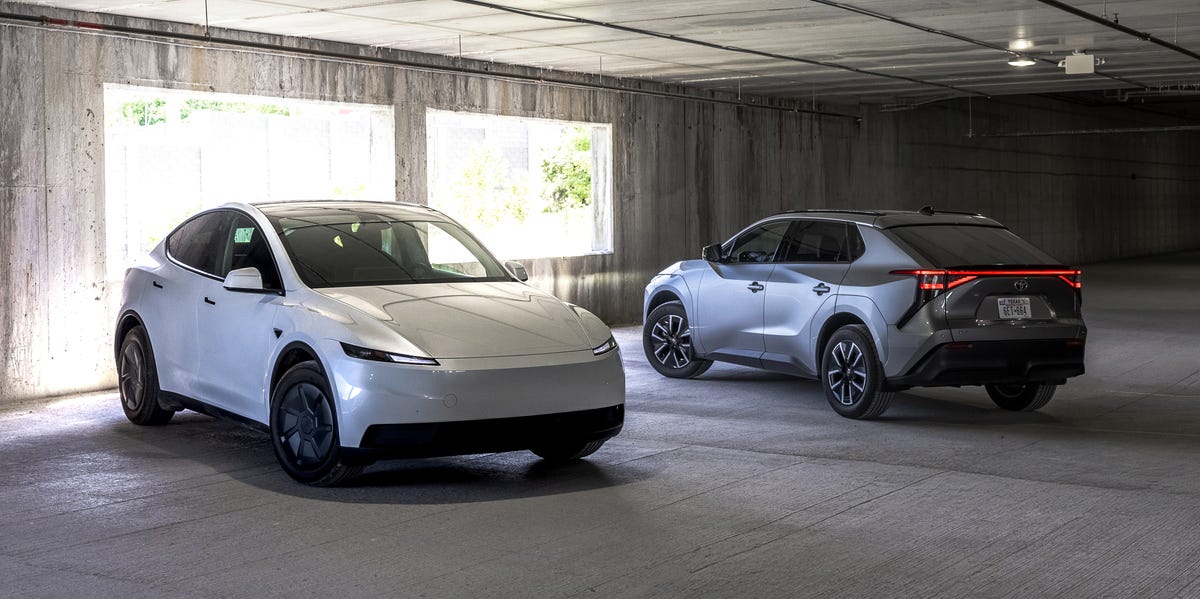
Tesla created the EV template that legacy automakers have spent years trying to imitate, with results ranging from genuinely impressive to painfully derivative. When the Model Y became a global bestseller, it helped make electric vehicles mainstream and desirable. Meanwhile, Toyota was watching the EV revolution from the sidelines until it was forced to get in the game. Its first mass-produced attempt was the clumsily named bZ4X, which was co-developed with Subaru and felt like what happens when two inexperienced lab partners try an experiment by copying someone else's work.
Despite the half-baked result, Team Toyobaru eventually did their homework and turned in a much more competitive product. Surprisingly, Toyota's refreshed and renamed bZ has outsold every non-Tesla EV in America through the first quarter of 2026, though the Model Y remains entrenched atop the sales charts. What's interesting is how these two corporate Goliaths have taken very different paths to get here. While Tesla-stans and Toyota truthers will likely remain loyal to their respective brands, they share an audience who wants an electric SUV for less than $45,000. So, we put the most affordable versions of the new Tesla Model Y and the Toyota bZ head to head to find out which bestseller is better.
For 2026, Tesla gave the Model Y a comprehensive makeover. That includes a new base model rear-wheel-drive variant that starts at just $41,630. Our test car wore the Pearl White paint, which, frankly, isn't worth the $1000 upcharge over the no-cost Stealth Grey. The only other option is the $1500 Diamond Black. Tesla's Full-Self Driving (Supervised) is included for the first 30 days and then costs $99 per month, but can be canceled at any time. Previously, it was an $8000 stand-alone option, so the subscription is a much better value.
 View Price on Amazon
Toyota also tinkered with the EV formerly known as bZ4X. Along with a rhinoplasty and a more user-friendly dashboard layout, the 2026 bZ adopts upgraded electric motors, new battery packs, and the NACS charge port that grants access to Tesla's vast Supercharger network; an improved 11.0-kW onboard charger makes Level 2 fill-ups less time-consuming too. The bZ also remains one of the least expensive new EVs you can buy, with the front-wheel-drive XLE starting at a low $36,495. However, we sampled the XLE Plus, which is $3000 extra but includes a more powerful electric motor and a bigger battery pack for increased driving range. The $475 Heavy Metal (gray) paint includes body-colored fenders for a more cohesive look. With about $800 worth of needless accessories, the as-tested price still totaled a reasonable $40,769.
With Tesla and Toyota both giving their representatives new looks, you'd think there'd be something to get excited about. While most new Model Ys adopt a Cybertruck-like front light bar and a more chiseled chin, the base version goes without those to help you save a buck. The standard 18-inch steel wheels have aero-friendly hubcaps, but they only make an already-anonymous SUV look more like the royalty-free botmobiles you have to avoid in video games. Sure, you can upgrade to larger 19-inch alloys, but they cost $1500, and by the EPA's measuring stick you'll lose nearly 20 miles of range. The bZ's exterior design isn't as dorky as the Model Y's, though it won't turn many heads either. The Toyota's "hammerhead" front lighting signature, creased body sides, and 18-inch wheels at least help its curb appeal.
Source: caranddriver.com

