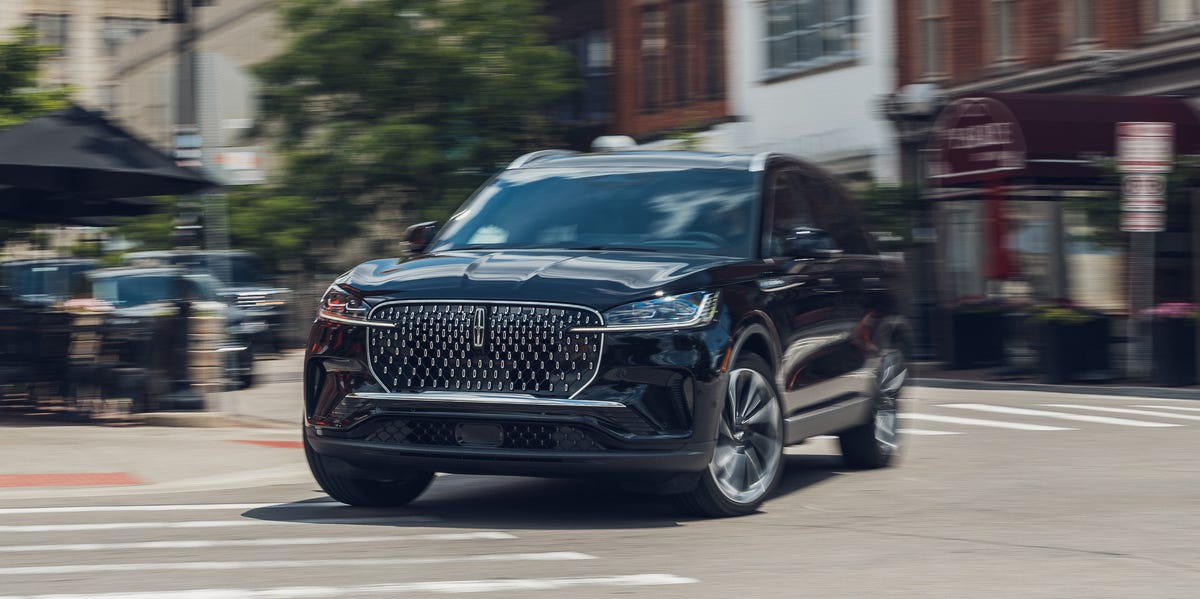
Lincoln's mid-size three-row SUV serves up traditional virtues in understated style. Few auto companies embrace the laid-back vibe as much as Lincoln. The brand is all about unstressed, relaxing transport, which is what luxury automobiles used to promise back in the days before modern ideas such as cutting-edge performance, futuristic tech, or off-road prowess became prevalent among bucks-up brands.
The Lincoln Aviator largely hews to this traditional notion of luxury, which it pulls off fairly convincingly despite being mechanically related to the more pedestrian Ford Explorer. In size and scale, the Aviator stands a respectful distance behind the big-dog Lincoln Navigator, but the family resemblance is clear.
 View Price on Amazon
The Aviator can get a little close to the Navigator in price—at least if you're looking at the range-topping Black Label, which starts at a heady $87,605. The value proposition is much better a little further down the lineup, with the rear-wheel-drive Premiere starting under $60K and the better-equipped Reserve coming in at $68,425 to start. That's the model we tested, with all-wheel drive and a handful of options pushing the price to $82,300.
The Aviator's optional plug-in hybrid powertrain was decommissioned a few years back, but that's not so sad, really, since it added a prodigious amount of weight and significant cost. All models now come exclusively with a twin-turbocharged 3.0-liter V-6 that spins out a hearty 383 horsepower and 415 pound-feet of torque. A 10-speed automatic handles the shifting.
This powertrain is a vehicle highlight. Nearly 400 horses are plenty in this application and a good deal more than you'll find in the Infiniti QX60 or the nonhybrid versions of the Volvo XC90 and the Lexus TX. At our test track, the Aviator hustled to 60 mph in 5.6 seconds, which is nearly two seconds quicker than the most recent QX60 we tested and more than a second ahead of the XC90 B6 and the TX350.
Out on the street, this boosted V-6 is unstressed, smoothly getting you up to speed. The 10-speed automatic packs a lot of gears, but it never seems busy and operates unobtrusively in the background. Drivers can switch from the default Normal drive mode to the sportier Excite mode (there's also Slippery, Conserve, and Deep Conditions), but the peppier drive mode doesn't notably alter the proceedings and is hardly necessary to achieve satisfying throttle response.
The V-6 does have a bigger appetite for premium unleaded than its turbocharged four-cylinder competitors do. EPA estimates for the all-wheel-drive Aviator are 17 mpg city and 25 highway; we saw 24 mpg in our 75-mph highway test. The EPA rates the XC90 B6 and the TX350 AWD at 20/26 mpg, and the Volvo matched that highway result in our hands.
Source: caranddriver.com