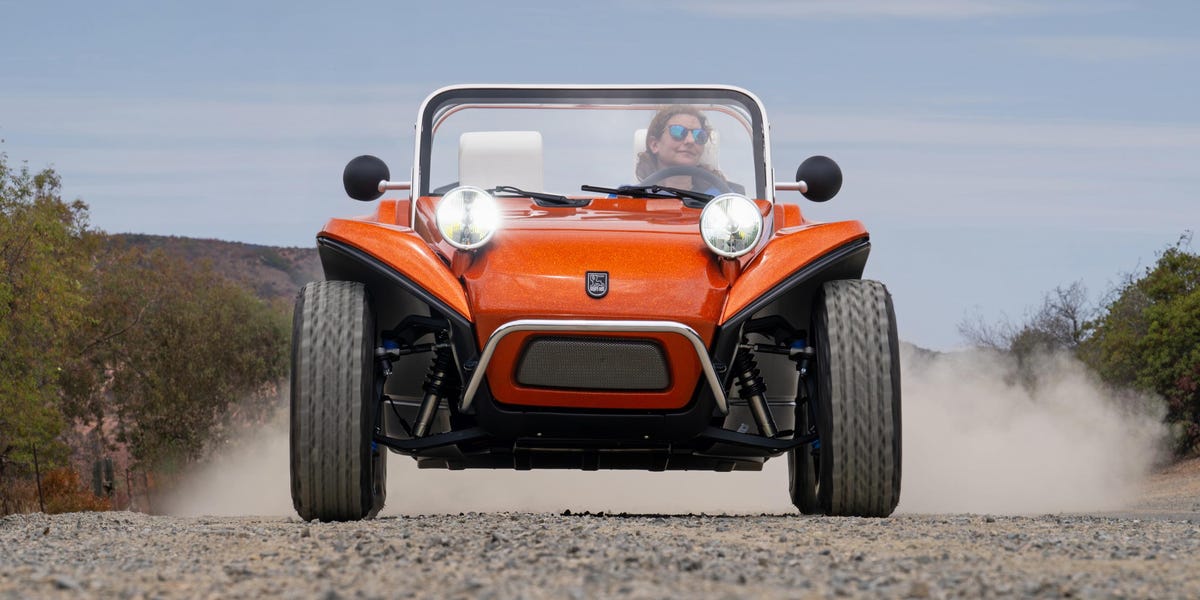
It's take two for the electric Meyers Manx revival, and we get a preview drive before its debut at The Quail during Monterey Car Week. There's the adorable, bouncy, fiberglass shell, finished in a metallic orange that boasts more glitter than a bass lure. At the front, cheerful fender-mounted headlights make eyes at all the passing cuties, and you, in your open-air buggy, are a cutie yourself.
Beneath its familiar, friendly exterior, though, this Manx has a secret. It's one you'll discover as soon as it wooshes by with no Volkswagen clatter or shouty flat-six, just the giggles of the driver and passenger over the whirr of an electric motor. Meyers Manx has been kicking around the idea of an electric buggy for more than a decade.
 View Price on Amazon
Manx's inventor, Bruce Meyers, had been considering it back in 2014, well before he sold the company to Phillip Sarofim and Freeman Thomas, but he never got past the golf-cartish mock-up stage. Under Thomas and Sarofim, a street-legal electric Manx became a reality, with a sophisticated prototype first seen on the lawn of The Quail during Monterey Car Week in 2022. On Friday, August 14, 2026, the Manx EV will return to The Quail, now in (nearly) production trim.
We weaseled our way into a test drive before the Manx team packed up for Monterey and went ripping through the hills above Lake Forest, California, in a Launch Edition Manx 2.0. The production Manx 2.0 isn't identical to the prototype we first covered. The range is less, the weight is more, and it's likely not quite as zippy as the initially proposed 4.5-second zero-to-60-mph run.
"We've gone through various iterations trying to find the right combination of construction, battery, powertrain," says Manx head of sales, Chet Parsons. "The first car was a showpiece concept car. The production car is more in line with the originals in some ways while functionally improving it in others." The electric Manx maintains similar dimensions to the original, with a nearly identical height and wheelbase, but it's shorter and wider overall.
The main visual differences are a deeper tub to contain the L-shaped, liquid-cooled battery and a closed-off rear panel, since there's no need for an engine cut-out. Instead of hanging out the back, the propulsive elements of the 2.0 are sandwiched under the belly and at the rear axle. A single motor and 45-kWh battery send 181 horsepower and 385 pound-feet of torque to the 265/70R-15 General Grabber all-terrain tires at the rear. Narrower 205 Grabbers handle the steering at the front.
Manx says the combo should be good for an estimated 100 miles of range, which is about as long as you'd want to drive in an open buggy before stopping to reapply sunscreen. There wasn't time for track testing before Monterey. Still, with more than double the power of a stock Beetle engine (even the high-horsepower versions), the E-Manx is undoubtedly quicker off the line than the other performance options in the Manx lineup, which include a 100-hp souped-up VW four-cylinder and a wild 130-hp radial engine.
Source: caranddriver.com